Search
AUTHENTIC & BEAUTIFUL
JAPANESE SWORDS AND FITTINGS
Japanese
ABOUT US
TOUKEN MATSUMOTO
OUR SHOPS
BLOG
NEW
SWORDS
FITTINGS
SWORDS
TACHI & KATANA
WAKIZASHI
DAISHO
TANTŌ & KEN
YARI & NAGINATA
KOSHIKIJU
Cleaning Kit
FITTINGS
TSUBA
MENUKI
FUCHI GASHIRA
KOZUKA
KŌGAI
FUTATOKORO /
MITOKORO
KOSHIRAE
OTHER
LEARN
Video Archive
NBTHK
NBTHK Criteria
Time Periods
Parts of the Katana
Blade Shapes
Patterns in the Hamon
Patterns in the Bōshi
File Patterns
Tang shapes
Cleaning Your Blade
ORDER
SALES RULES
PURCHASING
DELIVERY PROCESS
CONTACT US
Contact Us
Japanese
New
SWORDS
FITTINGS
Swords
TACHI & KATANA
WAKIZASHI
DAISHO
TANTŌ & KEN
YARI & NAGINATA
KOSHIKIJU
Cleaning Kit
Fittings
TSUBA
MENUKI
FUCHI GASHIRA
KOZUKA
KŌGAI
FUTATOKORO・MITOKORO
KOSHIRAE
OTHER
About
TOUKEN MATSUMOTO
OUR SHOPS
BLOG
Order
SALES RULES
PURCHASING
DELIVERY PROCESS
CONTACT US
Learn
Video Archive
NBTHK
NBTHK Criteria
Time Periods
Parts of the Katana
Shapes
Patterns in the Hamon
Patterns in the Bōshi
File-Patterns
Tang shapes
Cleaning Your Blade
Touken Matsumoto is a proud member of the All Japanese Sword Traders Association and NBTHK (Nihon Bijutsu Token Hozon Kyokai). We are also licenced by the government of Chiba Prefecture.
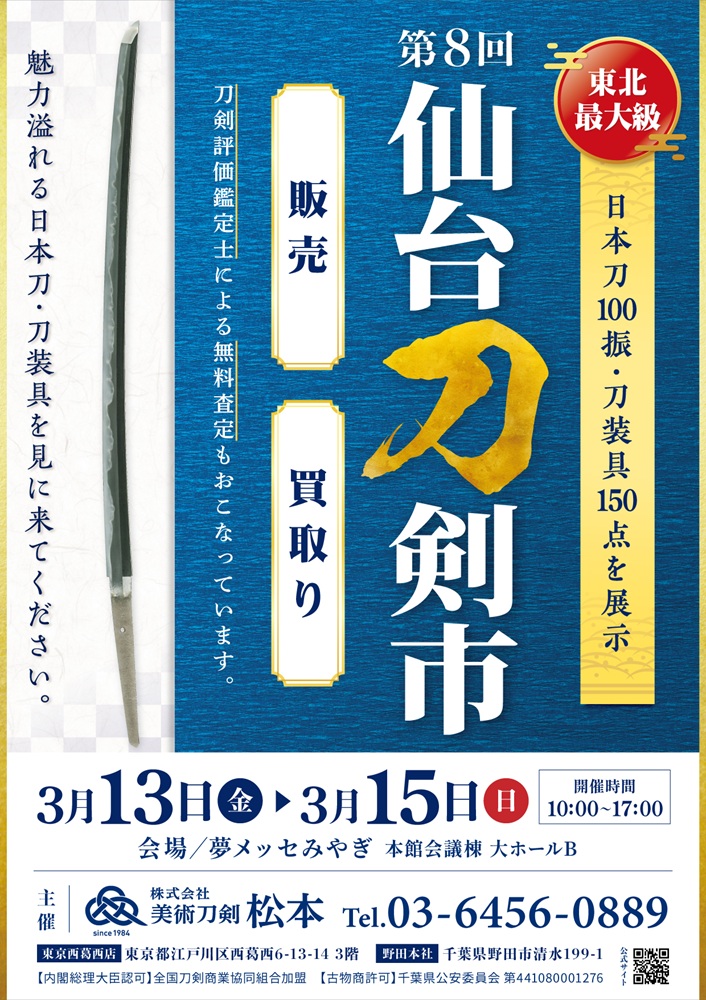
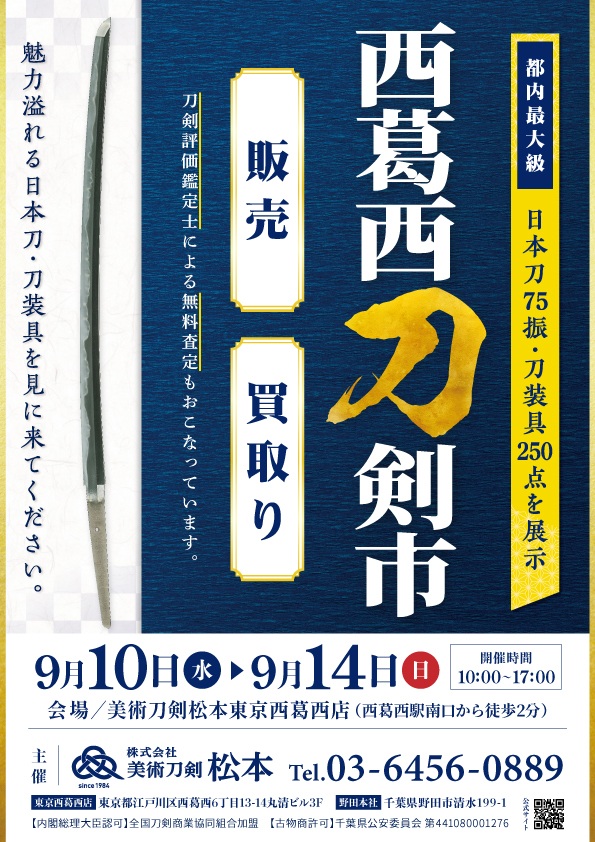
2026 Exhibition and Sales Event Schedule
The 26th Noda Token Ichi
3 days from Friday, January 23rd
The 14th Koriyama Token Ichi
3 days from Friday, February 13th
BLOG
New Illuminated Platform Sign
Feb. 26
The 14th Koriyama Token Ichi
Feb. 16
Parking Information for Visitors to Our Tokyo Nishi-Kasai Shop
Feb. 11
The 26th Noda Token Ichi
Jan. 26
Happy New Year 2026
Jan. 1
Product Updates
Mar. 10
The 2 tosogu have been placed in a drop-in box
Mar. 9
1Katana, 1 Wakizashi and 1 Tsuba uploaded
Mar. 8
1 Wakizashi and 1 Yari uploaded
Mar. 7
2 Katana uploaded
Mar. 7
2 Fuchi-kashira, 1 Tsuba, 1 Kogai and 1 Menuki uploaded
Mar. 2
1 Wakizashi and 1 Katana uploaded
Feb. 26
1 Katana uploaded
Feb. 21
1 Menuki uploaded
Feb. 20
1 Wakizashi and 2 Menuki uploaded
Feb. 17
2 Menuki uploaded
We accept PayPal and Credit Cards
Our site is secured by DigiCert EV SSL
Touken Matsumoto (刀剣松本)
Business calendar
Video Guidance by
Super Samurai Market
 Search